Your child points at m, a, and p and says all three sounds. Then you ask what word they make. Silence. Or a guess that has nothing to do with the letters.
Knowing the sounds and putting them together are two different skills. If the sounds come out with long gaps between them, your child has to remember each one before they can hear the word. You can help by showing them what happens when the sounds touch.
Try this today: Write map. Slide a finger under the letters from left to right, stretching the m straight into the short a, then saying a quick p. Say map normally. Do it together once, then give your child a turn.
What Does Blending Sounds Mean?
Blending means joining sounds in the order you hear or see them to make a word. If you say the three sounds in map and your child says map, that's oral blending. If they look at the letters, say the sounds they represent, and join them, they're decoding a printed word.
Segmenting goes the other way: start with the word map and pull it apart into three sounds. Blending helps your child read a word; segmenting helps them work out what to write.
The Institute of Education Sciences' foundational reading guide recommends teaching children to blend sounds from left to right to produce a recognizable word. Here's what that can look like at your kitchen table.
How to Teach Blending Sounds in 5 Steps
1. Start With a Word They Can Hear
Try a quick listening game before you bring out the letters. Say the sounds in am, with a small gap between the short a (as in apple) and m. Ask, “What word did I say?” If your child isn't sure, bring the sounds closer together, then say am normally. Let them copy you.
Try sun next if they're ready for three sounds. Say the sounds, then ask them to tell you the word. You can make it a tiny treasure hunt: after they blend the sounds in sock, they can go find one. Use a word they already know by ear; otherwise they may blend it correctly without knowing what it means.
2. Pick Letters Your Child Already Knows
Write m, a, and p on scraps of paper. Ask your child for the sound each letter makes in map, not the letter name. If they say “ay” for a, model the short sound in apple and have them repeat it. If several sounds are unfamiliar, practice those sounds first, then return to the word.
You don't need to wait until they've learned all 26 letter sounds. You need a few sounds they can recall and a word you can build with those sounds. Start with lowercase letters, since that's how most of the words they'll read appear on the page.
3. Slide From the First Sound to the Last
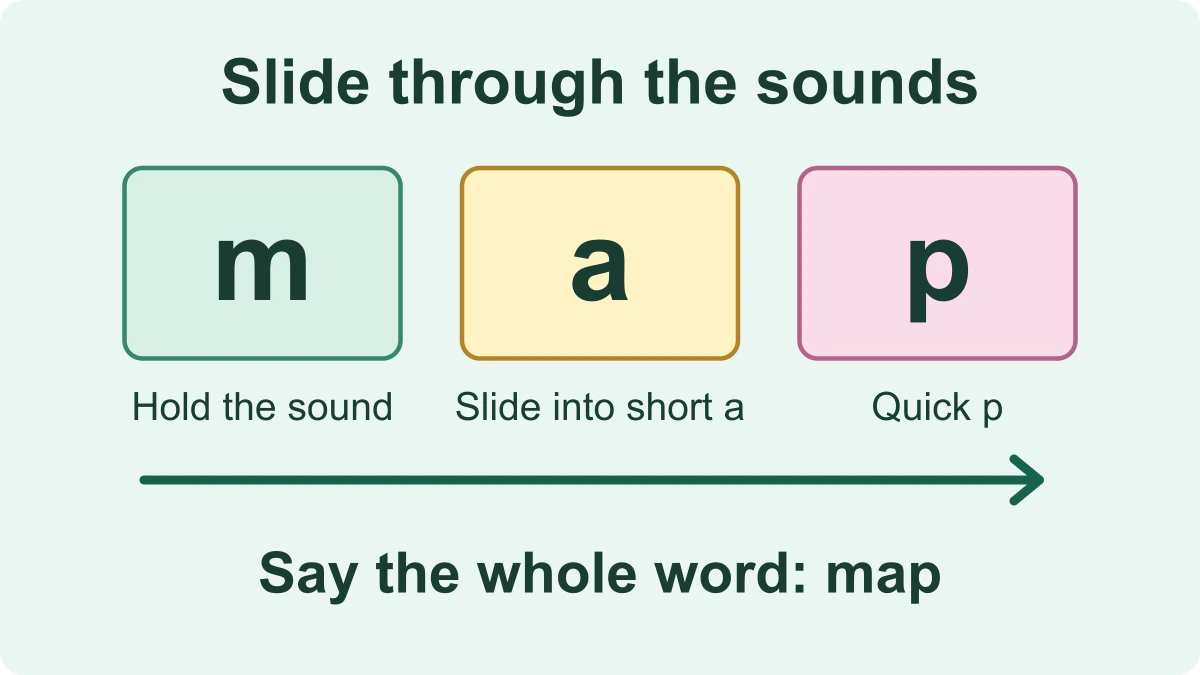
Your turn: Put a finger under m and say “mmm.” Keep going into the short a without stopping, then finish with a quick p. Take your finger back to the start, sweep under the whole word, and say map in your usual voice.
Together: Say, “Let's slide through it together.” Let your child move the finger while you say the sounds with them. The slide makes it easier to keep their place.
Their turn: Point to map and say, “Now you try.” If they say the three sounds separately, acknowledge what they got right: “You found all three sounds. Let's say them closer together.”
Keep the sounds clean. You can hold m, s, and f. You can't stretch p in the same way. Say it quickly without adding “uh.” “Mmm-aa-p” is much easier to turn into map than “muh-a-puh.” Here “aa” means the short vowel in apple, stretched slightly; it does not mean the letter name “ay.” The Florida Center for Reading Research's kindergarten family guide also recommends starting with sounds you can stretch and avoiding the extra “uh.”
4. Change One Letter and Read Again
Build map, then swap m for s to make sap. Next swap p for t to make sat. Give your child time to blend the whole new word each time. If sap is new to them, explain that it's a liquid inside a plant or tree.
One letter change is enough. If your child keeps saying map after the swap, ask, “Which letter changed? What sound does it make?” Then go back to the beginning and blend the new word. You can also try Nino's CVC Word Builder for another way to practice putting sounds in order.
5. Read the Word in a Short Line
Once your child can blend Sam, sat, and mat, try Sam sat. If they also know the words on and a, you can extend it to Sam sat on a mat. If they stop at sat, have them blend it and then reread the line from the beginning to hear the whole thought.
Check the meaning with an easy question: “What did Sam do?” Use a picture or act out the sentence after reading it. Pictures help explain what a word means, but when your child is working out the word itself, send their eyes back to the letters.
Which Words Should You Start With?
Start with short, familiar words that use sounds your child has already learned. A consonant-vowel-consonant word, or CVC word, such as sun is a good choice. A word starting with s, m, f, or n gives a beginner a sound they can hold while moving to the vowel.
| What to practice | Words to try | What to notice |
|---|---|---|
| Join two sounds | am, in, at | Can they say the word after hearing both sounds? |
| Blend with a sound they can stretch at the start | mat, map, sat, sun, fan, fin | Can they move into the vowel without a long gap? |
| Blend with a quick sound at the start | cat, tap, pig, dog | Can they say the first sound without adding “uh”? |
| Reread after one letter changes | fan → fin → fit | Do they read what's on the page rather than repeat the previous word? |
Choose two or three examples from one row. You can change the vowel when your child is ready to pay attention to it. If they keep mixing up fan and fin, work on the two vowel sounds and return to one word at a time.
A Five-Minute Blending Practice Plan
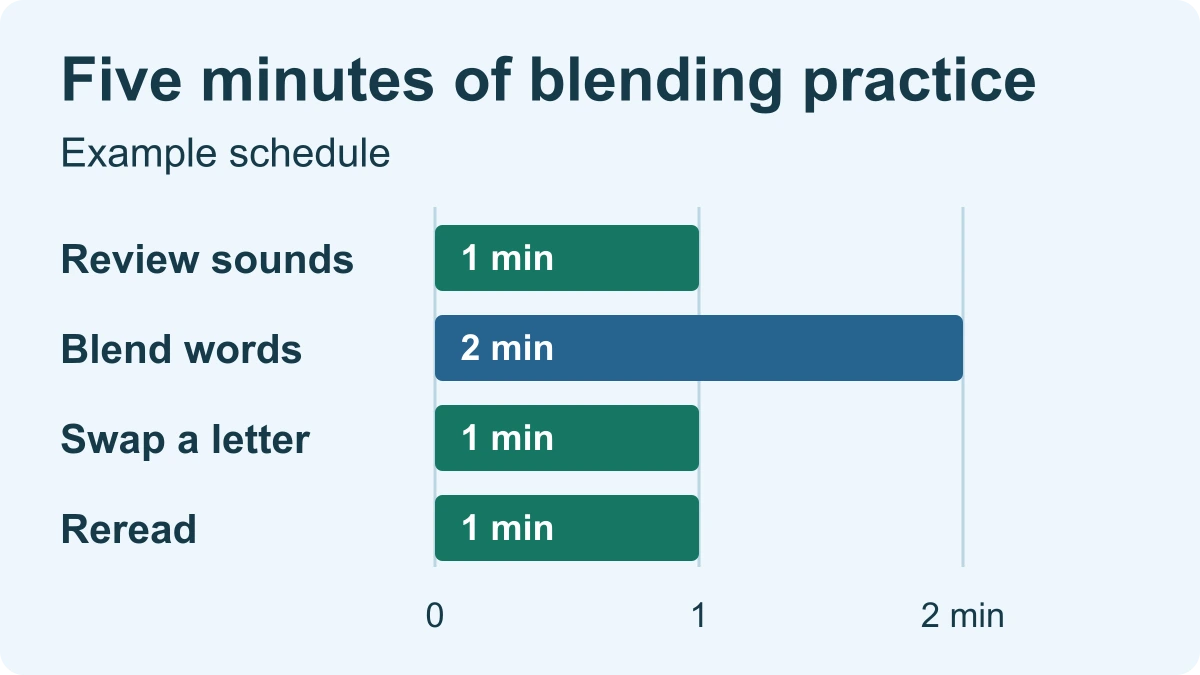
The chart is one way to spend five minutes, not a target your child has to meet. Stay with the part they need, even if you don't get to all four.
- Review sounds (1 minute): Show m, a, s, t, and p. Help with any sound your child can't recall.
- Blend words (2 minutes): Model map, blend mat together, then let your child try sat.
- Swap a letter (1 minute): Change sat to mat. Ask them to read the new word from the beginning.
- Reread (1 minute): Reread a word they worked out or try Sam sat if they know the sounds. Ask what it means.
The next time you practice, offer a different word with familiar sounds. Reading a new word such as pat after practicing mat tells you more than reading mat from memory. Notice whether your child needed a full model, a little help, or no help. Leave the stopwatch out of the reading itself.
What to Do When Your Child Gets Stuck
They say all the sounds but can't hear the word. Go back to two sounds, such as those in am. Slide them together yourself, say the whole word, and let your child echo you. When they can hear the word, try a three-sound word with a stretchable first sound.
They read the first letter and guess the rest. Say, “You noticed the first sound. What comes next?” Point under the vowel, then the last letter. Blend the whole word together. Save the picture clue for after they read it.
They leave off the last sound. Put a dot under the last letter and pause your finger there just long enough to notice it. Model a short final sound and reread the word. For mat, listen for the quick t at the end.
They forget the letter sounds. Give them the sound and let them retry. Use a smaller set of letters the next day. Asking them to blend a word with several unfamiliar sounds makes it hard to tell which skill needs attention.
They get frustrated. Read the word together and stop on one they know. If your child regularly struggles to recall familiar letter sounds or blend them despite repeated supported practice, tell their teacher exactly what you see. “She can say the three sounds in mat, but can't join them yet” is more useful than “She's bad at reading.”
Frequently Asked Questions
Should I teach letter names or sounds first for blending?
Use sounds when you blend. Knowing that a letter is called em is useful, but em-ay-pee won't turn into map. You can teach names and sounds alongside each other; just make clear which one you want in the moment.
Does my child need to know the whole alphabet first?
No. Start with the letter sounds they know well enough to read a few short words. Add new words as they learn more sounds.
Is blending sounds the same as learning consonant blends?
No. Blending is the action of joining sounds in any word. A consonant blend is a group of consonants, such as st in stop, in which you can still hear both sounds. A child can practice blending mat without learning st yet.
Should my child say each sound separately before blending?
They can point to each letter to check its sound, then sweep back through the word with fewer gaps. If the pauses are making them lose the word, model sliding the sounds together from the start.
How do I know when my child is ready for harder words?
Try an unfamiliar word made from familiar sounds. If your child can work it out with little or no help across several examples, add one new challenge at a time. For example, try a word with sh once they've learned that sh represents one sound.
Want a Teacher to Model Blending With Your Child?
Try the finger slide with map first. If you'd like someone to listen and help you work out whether to practice individual sounds or start reading words together, explore Nino's live online phonics classes.
Nino teaches children ages 3–6 in groups of up to six. The course moves from letter sounds to blending, three-letter words, and reading short sentences. You can watch a class sample or request a callback on the course page.