Many parents are surprised when their child can sing the full ABC song but still cannot read simple words like cat, mat, sun, or pin.
The child may know that A comes before B. They may point to a flashcard and say "A for Apple". They may even recite all 26 letters proudly. But when they see a new word, they freeze, guess from the picture, or wait for an adult to tell them.
That is not because the child is lazy. It is usually because the ABC was taught in the wrong order.
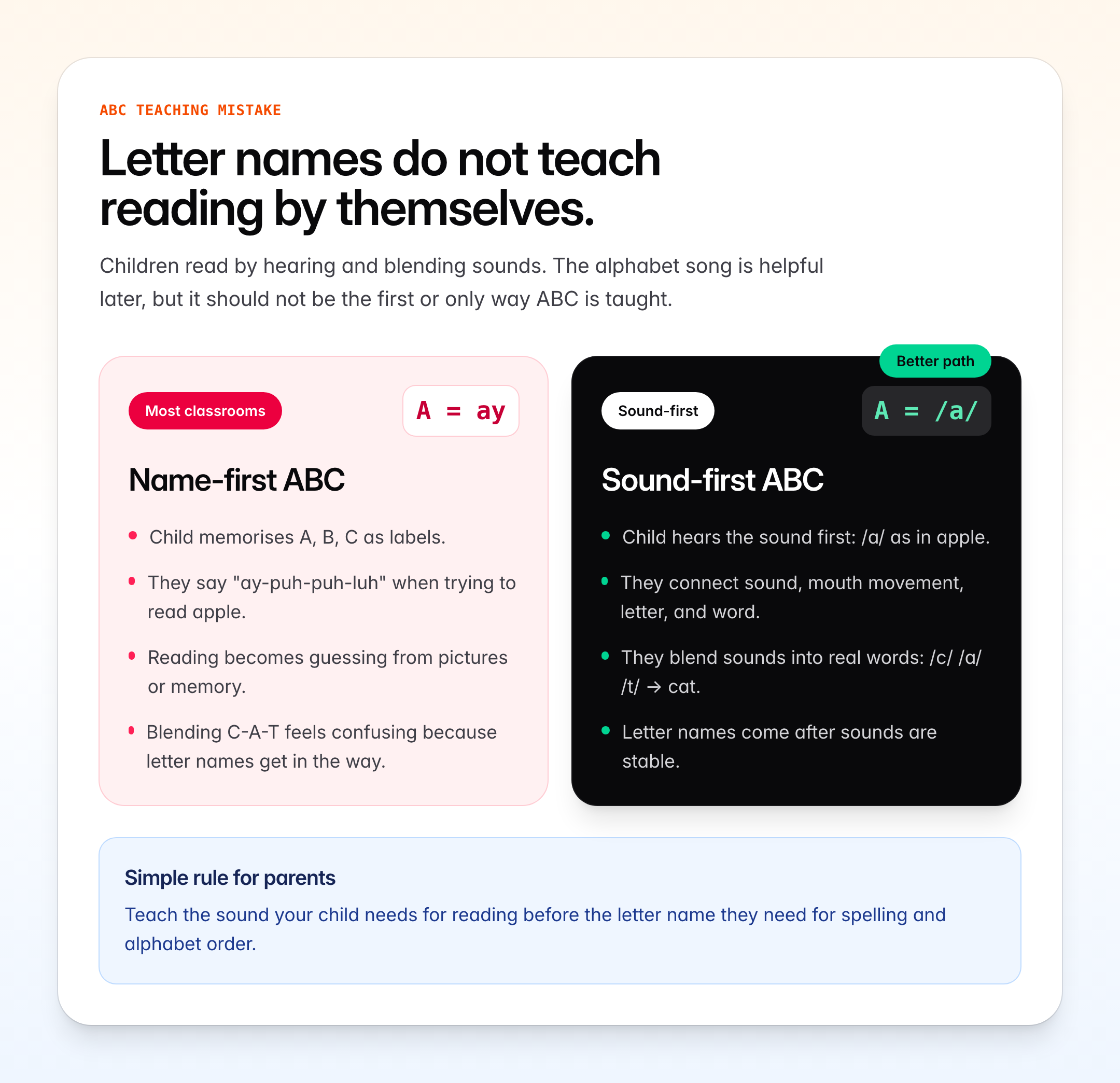
Most schools start with letter names: A, B, C, D. That feels natural because adults think of the alphabet as a list. But children do not read by saying letter names. They read by connecting printed letters to speech sounds and then blending those sounds together.
So the right question is not, "Does my child know ABC?"
The better question is:
Can my child hear the sound, say the sound, recognize the letter, and use it to read a word?
That is the real foundation of reading.
The problem with teaching ABC as letter names first
Letter names are useful. Children do need them eventually. But when letter names are taught before sounds, they can create confusion.
Take the word cat.
If a child sees C-A-T and thinks of the letter names "see-ay-tee", those names do not blend into cat. The child has to ignore the names and somehow discover the sounds /c/ /a/ /t/. That is a hard mental jump for a young learner.
Now imagine a child who has been taught the sounds first:
- C says /c/
- A says /a/
- T says /t/
Now C-A-T becomes /c/ /a/ /t/. Blend it together and the child can hear cat.
That is why sound-first ABC works better for reading.
What schools often get wrong
The mistake is not teaching the alphabet. The mistake is treating the alphabet song and "A for Apple" as reading instruction.
Here are the common problems:
- Too much focus on recitation. Children memorize the sequence A to Z, but do not learn what each letter does inside a word.
- Letter names come before letter sounds. The child knows "bee" but not /b/. They know "em" but not /m/.
- Every letter is taught with one fixed word. A becomes only apple, B becomes only ball. This encourages memory, not decoding.
- Writing is pushed too early. Children are asked to trace neat letters before they can hear and use the sound.
- Blending is delayed. Children spend months on isolated letters instead of using known sounds to read small words.
This is why a child may score well on alphabet worksheets and still struggle with reading.
The right goal: sound, symbol, and meaning
A strong ABC lesson connects three things:
- Sound: What do I hear?
- Symbol: What letter shows that sound?
- Meaning: Can I use that sound in a real word?
For example, when teaching M:
- The child hears /m/.
- The child feels lips closed while saying /m/.
- The child sees M and m.
- The child connects /m/ to moon, mat, mom, milk.
- The child blends /m/ with known sounds: am, mat, man.
That is much more powerful than only saying "M for Mango".
Teach sounds before names
The first thing a child needs is the sound.
When you show the letter S, do not begin with "This is ess." Begin with the sound /s/, like a snake sound. Let the child hear it, say it, and notice the air moving.
Then connect it to the symbol:
"This letter shows the /s/ sound."
Later you can say:
"Its letter name is S."
This order matters. Reading needs sounds first. Alphabet order and spelling conversations can use letter names later.
Use pure sounds, not extra sounds
One of the biggest mistakes adults make is adding a small "uh" after consonants.
For example:
| Letter | Avoid saying | Better sound |
|---|---|---|
| M | muh | /m/ |
| S | suh | /s/ |
| T | tuh | /t/ |
| P | puh | /p/ |
| B | buh | /b/ |
Why does this matter?
Because extra sounds make blending harder. If a child says "muh-a-tuh", the word becomes muddy. But /m/ /a/ /t/ blends cleanly into mat.
Adults do not need to be perfect phonetics experts. But they should try to keep sounds short and clean.
A better 10-minute ABC routine
You do not need a long class to teach one letter well. A short, focused routine works better than a noisy worksheet session.
Use this flow:
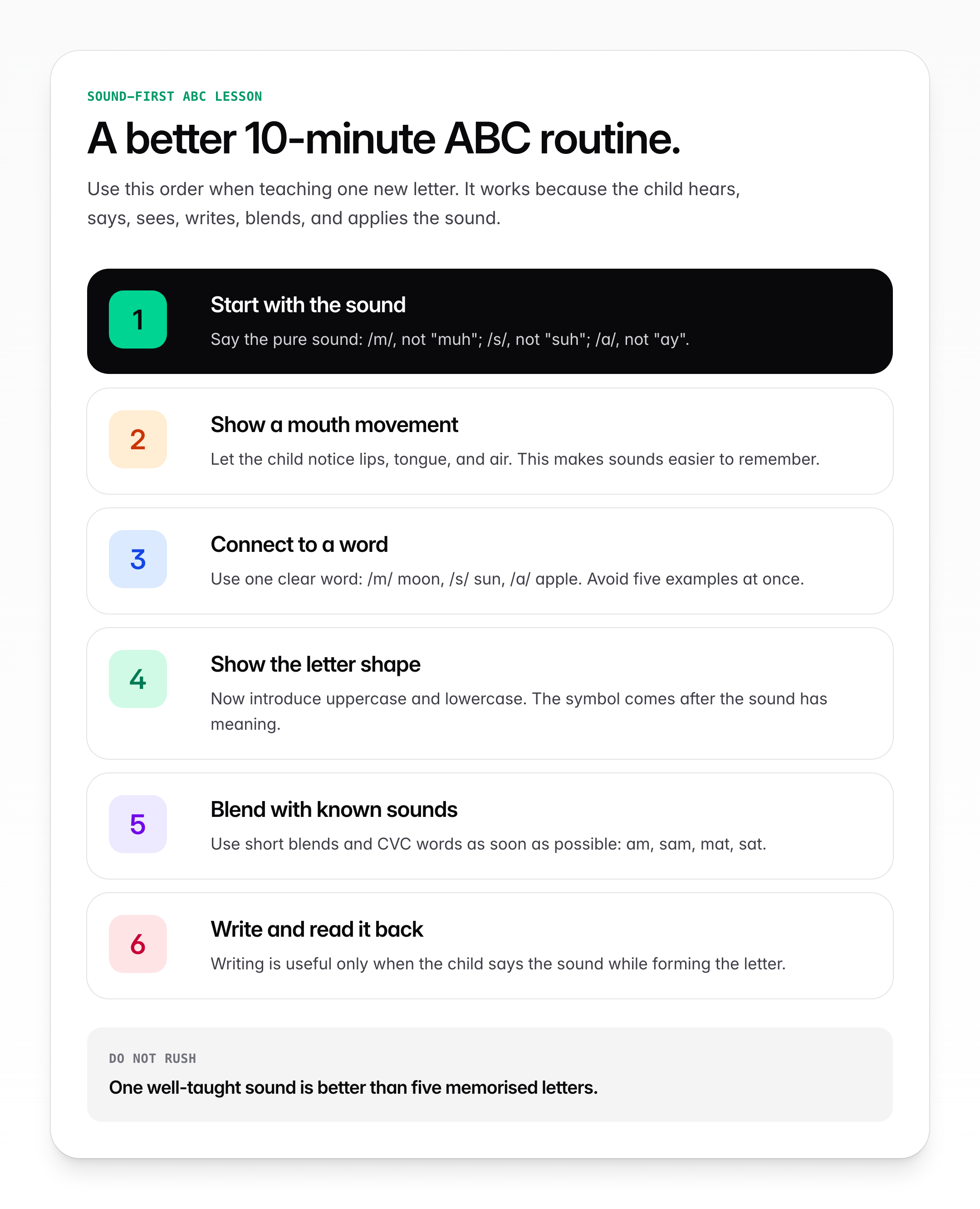
1. Start with the sound
Say the sound clearly. Keep it short. Ask your child to listen first, then repeat.
Example:
"Listen: /m/. Your turn: /m/."
Do not begin by asking the child to name the letter. Begin with listening.
2. Show the mouth movement
Young children learn well through the body. When teaching /m/, ask them to close their lips. When teaching /f/, let them feel the air. When teaching /s/, show the long hiss.
This makes the sound less abstract.
3. Connect the sound to one clear word
Use one strong example first.
"/m/ as in moon."
Do not give too many words at once. Five examples can overload a small child. Start simple, then add more examples after the sound is stable.
4. Show uppercase and lowercase
After the sound has meaning, show the letter shape.
"This is M. This is m. Both can show the /m/ sound."
Point out the difference between capital and small letters, but do not turn the lesson into handwriting practice too quickly.
5. Blend with known sounds
As soon as your child knows a few sounds, start blending.
If the child knows /s/, /a/, /t/, and /m/, they can read:
- at
- sat
- mat
- am
This is where reading begins. Not after all 26 letters are memorised. Reading begins when the child can use two or three sounds together.
6. Write and read it back
Writing is useful when it supports sound. Ask the child to say the sound while writing the letter.
For example:
"Write m. Say /m/ while your pencil moves."
This connects hand, eye, ear, and mouth.
Do not teach A to Z in alphabet order only
Alphabet order is useful for dictionaries, songs, and general knowledge. But it is not the best order for learning to read.
In phonics, many teachers introduce sounds in an order that helps children read words quickly. For example, if a child learns s, a, t, p, i, n early, they can soon read words like:
- sat
- pin
- tap
- nap
- sit
That gives the child a powerful feeling: "I can read."
If you teach only A, B, C, D in order, early blending becomes slower because the child may not have enough useful sound combinations.
This is why structured phonics classes often use a planned sound sequence instead of simple alphabet order.
What about "A for Apple"?
"A for Apple" is not wrong. It is just incomplete.
The problem is when it becomes the whole lesson.
A better version is:
"Apple starts with /a/. This letter can show /a/. The letter name is A."
Notice the order:
- Word
- Beginning sound
- Letter symbol
- Letter name
That order helps the child understand reading.
How to know if your child is learning ABC the right way
Use these quick checks.
Your child is on the right path if they can:
- say the sound for a letter without always needing the letter name
- hear the first sound in simple words
- match a sound to the letter that represents it
- blend two or three sounds into a word
- read simple CVC words like cat, mat, sat, pin, sun
- write a letter while saying its sound
Your child may need more sound-first practice if they:
- can sing ABC but cannot read small words
- guesses words from pictures
- says letter names while trying to blend
- adds "uh" after every consonant
- memorizes words but cannot read new ones
- gets confused between uppercase and lowercase forms
A simple home practice plan
Keep it short. Ten minutes is enough.
Day 1: One sound
Teach one sound using the routine above. Use one clear word and one letter shape.
Day 2: Sound hunt
Ask your child to find the sound in the room.
"Can you find something that starts with /m/?"
Moon, mat, mug, milk, mom. Real objects make learning stick.
Day 3: Letter sorting
Mix 3 or 4 letters your child already knows. Ask:
"Which one says /m/? Which one says /s/?"
Keep it playful. Do not turn it into a test.
Day 4: Blending
Use two or three known sounds to make small words.
For example: am, sat, mat.
If your child struggles, stretch the sounds slowly:
"/m/ ... /a/ ... /t/. Mat."
Day 5: Read and write
Ask the child to read one small word, then write one letter from that word while saying the sound.
This is enough. More is not always better.
What parents should avoid
Avoid these habits:
- Do not rush through all 26 letters just to finish the alphabet.
- Do not rely only on the alphabet song.
- Do not correct harshly when a child confuses sounds.
- Do not force long handwriting sessions before sound understanding.
- Do not make every lesson a worksheet.
- Do not teach only capital letters. Children must see lowercase early because most reading uses lowercase.
What good ABC teaching sounds like
Here is a simple script:
"This is the /s/ sound. Listen: /s/. Your turn. Good. Sun starts with /s/. Snake starts with /s/. This letter shows /s/. It is called S. Now let's blend /s/ /a/ /t/: sat."
That short script does more than a full page of tracing.
It teaches sound, meaning, symbol, name, and blending.
The final takeaway
The ABC is not just a song. It is a code.
Children need to understand how letters represent sounds. Once they understand that code, reading becomes less about guessing and more about solving.
So yes, teach the alphabet. Sing the song. Let children enjoy letter charts and alphabet books.
But if your goal is reading, teach sounds first.
Letter names help children talk about the alphabet. Letter sounds help children unlock words.
That is the right way to teach ABC.