Teaching counting to a 3-year-old sounds simple until you actually try it. Your child may say "one, two, three, four, five" very proudly, then count three toys as "one, two, five, eight."
That does not mean your child is weak in maths. It usually means they are still learning that counting is not just a song. Counting has rules: number words must stay in order, each object gets one number, and the last number tells how many there are.
So the right way to teach counting to a 3-year-old is not to start with worksheets. Start with real objects, short games, touch-counting, and daily routines. This guide gives you the exact step-by-step method.
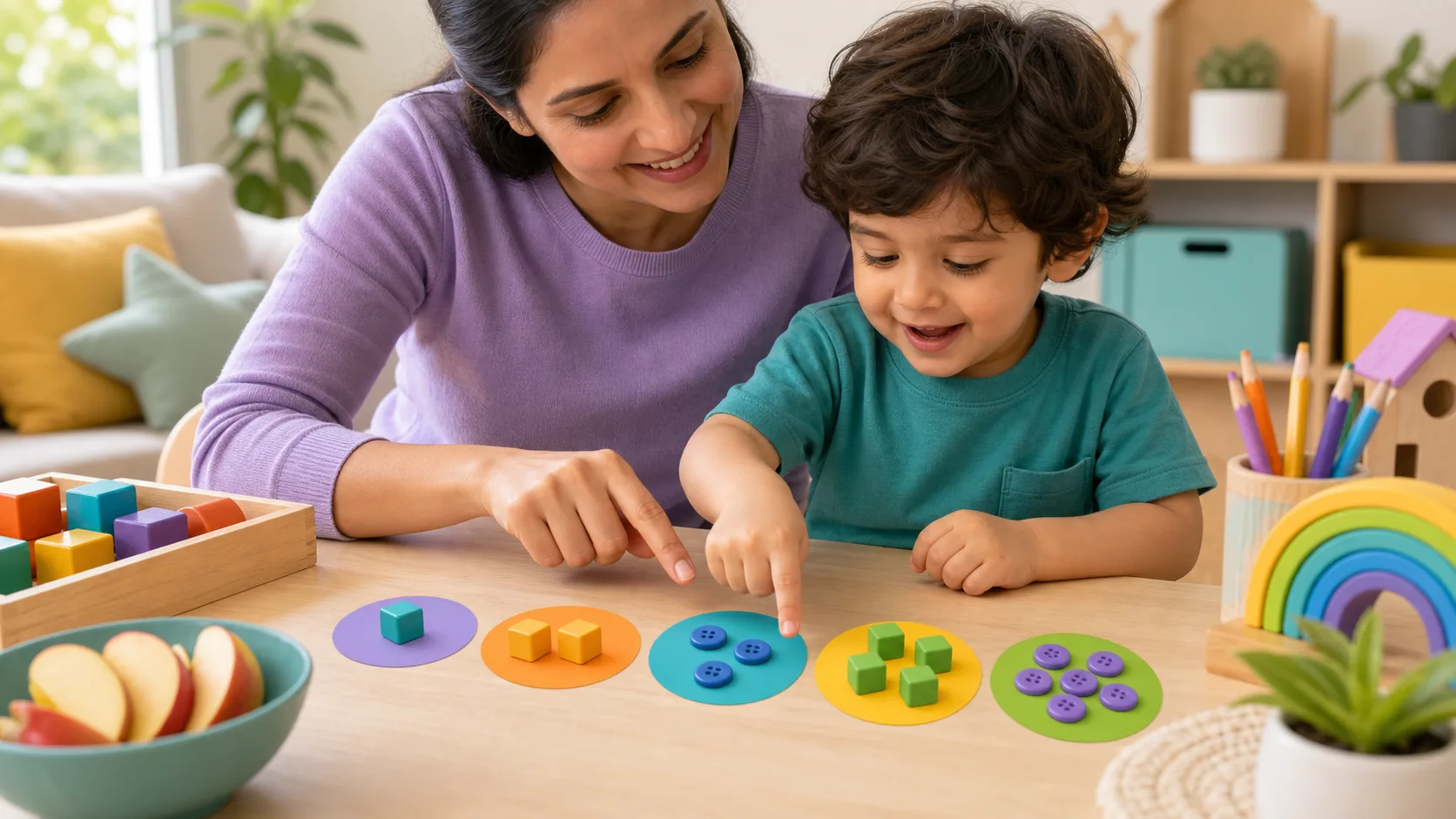
Quick answer: the best way to teach counting to a 3-year-old
Use this order:
- Count out loud in daily routines.
- Count only small groups first, usually 1 to 3, then 1 to 5.
- Ask your child to touch or move one object for each number word.
- After counting, ask "How many are there?"
- Repeat with snacks, blocks, stairs, fingers, toys, and storybooks.
- Add written numbers only after the child understands quantity.
The goal is not to make your 3-year-old count to 100. The goal is to help them understand what numbers mean.
What counting really means at age 3
Many parents think counting means reciting number names.
"One, two, three, four, five..."
That is only one part.
Researchers and early-math educators describe counting as a combination of several ideas. DREME at Stanford explains that object counting involves principles such as stable number order, one-to-one correspondence, cardinality, order irrelevance, and abstraction. In plain English, the child needs to learn:
- number words have a correct order
- each object gets counted once
- the last number tells the total
- objects can be counted in any arrangement
- different kinds of things can still form one countable group
That is a lot for a 3-year-old brain.
So if your child skips an object, counts the same toy twice, or says the numbers too fast, stay calm. They are not being careless. They are coordinating memory, language, attention, finger movement, and quantity at the same time.
What should a 3-year-old be able to count?
Most 3-year-olds are just beginning formal number understanding. Head Start's preschool math framework describes children from 36 to 48 months as saying some number words in sequence, starting with one, and beginning to coordinate verbal counting with objects for small groups.
That is the practical expectation.
A 3-year-old may be able to:
- recite some numbers in order, often up to 5 or 10
- count 2 or 3 objects with help
- understand words like more, less, one, two, many, all gone
- show small quantities with fingers
- match one object to one space, such as one cup for each plate
- recognize very small amounts without counting, like two crackers
Some children do more. Some do less. Development is not a race.
The CDC's 3-year milestone checklist also reminds parents to play counting games and count body parts, stairs, and everyday things. That is exactly the right tone: playful, daily, low-pressure.
Step 1: Start with number words in real life
Before a child can count objects, they need to hear number words often.
Do not make this a formal lesson. Just narrate life.
Try these:
- "One shoe, two shoes."
- "Let's take three steps."
- "You have two hands."
- "I am putting one spoon on the table."
- "We need three cups."
- "One, two, three... jump!"
This builds the counting sequence naturally.
Keep it short. A 3-year-old does not need a lecture about numbers. They need repeated exposure in meaningful moments.
Step 2: Use small groups first
Start with 1 to 3 objects. Then move to 1 to 5.
Not 20.
Not 50.
Definitely not "count all these 38 blocks" while you make dinner.
Small groups help your child see quantity clearly. A plate with two apple slices is easier to understand than a pile of mixed toys.
Good beginner objects:
- apple slices
- raisins
- blocks
- toy cars
- buttons
- spoons
- crayons
- small cups
- socks
Use objects your child can safely touch and move.
Step 3: Teach one-to-one counting
This is the big one.
One-to-one correspondence means your child says one number for one object. Not two numbers for one object. Not one number while pointing at the air. One number, one object.
The Erikson Institute explains that accurate counting begins when preschoolers assign one number, and only one number, to each object as they count. This requires timing: touch, say the number, move to the next object.
Here is the routine:
- Put 3 blocks in a straight line.
- Touch the first block and say "one."
- Touch the second block and say "two."
- Touch the third block and say "three."
- Ask your child to do it with you.
- Then let your child try alone.
If they rush, gently slow them down:
"Touch one block for each number."
If they skip a block, do not scold. Say:
"Let's check again. Did every block get a number?"
That one sentence teaches more than "No, wrong."
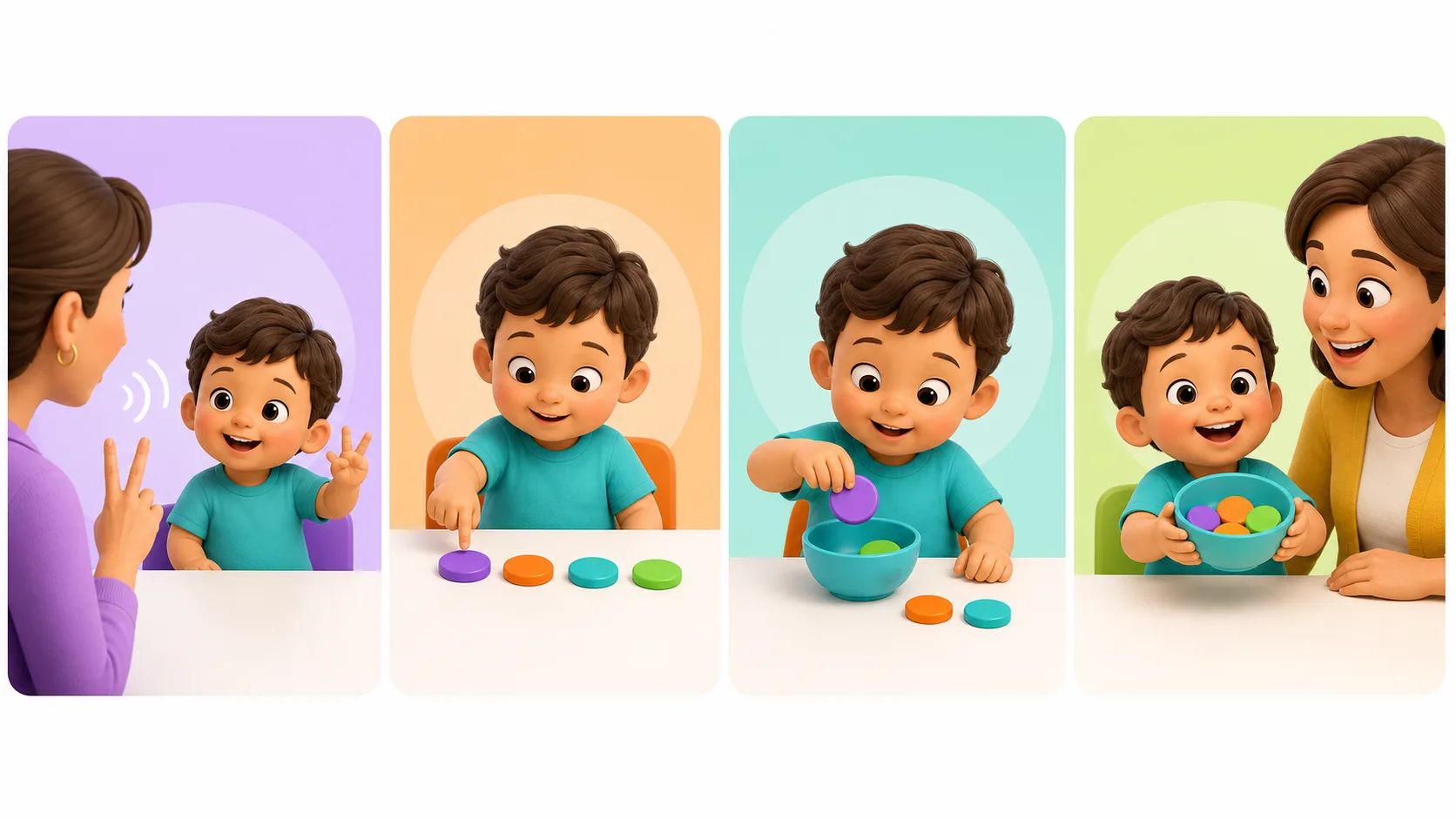
Step 4: Move counted objects to a new place
Some 3-year-olds lose track easily. They count the same object twice or skip one.
Moving objects solves this.
Try this:
- Put 4 buttons on the left side of the table.
- Ask your child to pick up one button.
- Say the number.
- Move that button to a bowl or another pile.
- Repeat until all buttons are moved.
This gives the child a visual difference between "already counted" and "not counted yet."
It also makes counting physical, which is exactly what many young children need.
Step 5: Ask "How many?"
This is where many parents miss the lesson.
After your child counts "one, two, three," ask:
"So how many blocks are there?"
If the child says "three," they are beginning to understand cardinality. Cardinality means the last number counted tells the total amount.
Head Start includes this as a key preschool math goal: children begin to understand that the last number represents how many objects are in a group.
Do not skip this question.
Counting without "How many?" can become a chant. Counting with "How many?" becomes quantity.
Step 6: Practice subitizing with tiny groups
Subitizing means seeing "how many" without counting one by one.
For example, most adults instantly know there are two eyes, two shoes, or three dots on a die pattern. We do not count each one every time.
DREME describes subitizing as an important early math foundation because it helps children connect small quantities with number words.
Try this with your 3-year-old:
- Hold up 1 finger. Ask, "How many?"
- Hold up 2 fingers. Ask, "How many?"
- Put 3 crackers on a plate. Ask, "Do you see 3?"
- Show 2 toy cars for two seconds, cover them, and ask, "How many cars?"
Start with 1, 2, and 3. Keep it playful.
Subitizing helps counting because children start understanding quantities, not just sequences.
Step 7: Count during routines
The best counting lessons happen inside normal life.
Use these moments:
| Routine | Counting idea | What to say |
|---|---|---|
| Stairs | stable order | "One step, two steps, three steps." |
| Snacks | one-to-one counting | "Touch each grape as we count." |
| Bath time | more and less | "Which cup has more water?" |
| Getting dressed | pairs | "Two socks. One for each foot." |
| Setting the table | one-to-one matching | "One plate for each person." |
| Story time | small quantities | "How many ducks are on this page?" |
| Clean-up | sorting and counting | "Put three blocks in the box." |
This is why home is such a good early math classroom. You already have the materials.
Step 8: Add number symbols slowly
Written numbers are useful, but they should not come first.
The symbol "3" is abstract. A child understands it better after they have touched three blocks, eaten three apple slices, jumped three times, and shown three fingers.
When your child is ready, connect symbol to quantity:
- Put 3 blocks on the table.
- Show the number card 3.
- Say, "This is 3. It means three things."
- Ask your child to match 3 blocks to the card.
Do the same with 1, 2, 3, 4, and 5 before rushing ahead.
A 7-day counting plan for parents
Use this for one week. Repeat it for 2-3 weeks if needed.
| Day | Activity | Time | Goal |
|---|---|---|---|
| Day 1 | Count body parts: eyes, hands, feet, fingers | 5 minutes | Hear number words |
| Day 2 | Count 3 snack pieces by touching each one | 5 minutes | One-to-one counting |
| Day 3 | Move 4 blocks into a bowl while counting | 7 minutes | Keep track |
| Day 4 | Show 1, 2, and 3 fingers quickly | 5 minutes | Subitizing |
| Day 5 | Count stairs slowly while walking | 5 minutes | Stable order |
| Day 6 | Set one plate for each family member | 7 minutes | Matching one to one |
| Day 7 | Play "How many?" with toys on the floor | 10 minutes | Cardinality |
Do not stretch this into a 45-minute class at home.
Three-year-olds learn better with short, repeated practice. A happy 5-minute counting game beats a forced 30-minute worksheet session.
Common mistakes parents make
Mistake 1: Teaching counting like a song only
Counting songs are useful. Use them.
But if your child can sing to 20 and cannot count 4 blocks, the song has not become number sense yet.
Add objects.
Mistake 2: Starting with worksheets
Worksheets can make a child look busy while understanding stays weak.
At age 3, real objects come first. Paper comes later.
Mistake 3: Using too many objects
Large piles overwhelm young children.
Use 2, 3, 4, or 5 objects first. Accuracy matters more than big numbers.
Mistake 4: Correcting too harshly
If your child says "one, two, four," do not panic.
Say, "Let's try again slowly."
A calm reset works better than pressure.
Mistake 5: Asking only "What number is this?"
Number recognition is not the same as counting.
Instead of only showing the written number 5, ask your child to make a group of 5 objects. That tells you whether they understand quantity.
Signs your child is ready for the next level
Your 3-year-old is making good progress if they can:
- count 3 to 5 objects with help
- touch one object for each number word
- answer "How many?" after counting a small set
- show 1, 2, or 3 fingers correctly
- compare small groups using more, less, or same
- enjoy counting in daily routines
They may be ready for harder work if they can:
- count 5 objects accurately without help
- count objects in a messy arrangement
- recognize groups of 2 or 3 without counting
- match written numbers 1 to 5 with quantities
- understand "one more" in simple situations
Move slowly. Strong foundations matter more than speed.
What if my 3-year-old refuses to count?
Then stop making it look like a test.
Count things they care about:
- toy cars
- dinosaurs
- dolls
- mango pieces
- chocolate chips
- bubbles
- steps to the park
- jumps on the mat
Also, let them be the teacher.
Ask:
"Can you teach teddy how to count these blocks?"
Children often resist being tested but love helping a toy "learn."
When should you consider structured math classes?
Home counting games are enough for many 3-year-olds. But structured support helps when:
- your child is ready for more than counting
- you want a planned KG-to-grade path
- your child struggles with number sense
- your child needs a teacher who can spot mistakes early
- you want math to feel playful, not scary
Nino's Online Maths Classes for Kids are designed for ages 4 to 14, from KG to Grade 8. For younger children, we focus on number sense, comparing and ordering numbers, shapes, patterns, basic addition, basic subtraction, measurement, money, and time.
The goal is not just "finish the syllabus." The goal is learning outcomes: a child who can explain, solve, and feel confident with math.
Simple counting games for home
Use these whenever you have 5 spare minutes.
1. Feed the toy
Give a teddy 3 pretend biscuits. Count each one as your child places it near the toy.
2. Parking lot count
Draw 5 parking spaces. Ask your child to park one toy car in each space and count the cars.
3. Jump and count
Ask your child to jump 3 times. Count each jump out loud.
4. Button bowl
Move buttons one by one into a bowl while counting slowly.
5. Storybook counting
Open a picture book and ask, "How many birds do you see?" Start with pages that show 1 to 3 items.
6. Snack shop
Pretend each snack costs 1, 2, or 3 coins. Your child counts and "pays."
7. Missing object
Show 3 blocks. Hide one. Ask, "How many are left?" Keep it playful, not quiz-like.
The final takeaway
To teach counting to a 3-year-old, keep the lesson concrete.
Say number words in order. Count small groups. Touch one object at a time. Move counted objects. Ask "How many?" Use snacks, stairs, toys, fingers, and stories. Add written numbers only after the child understands quantity.
This is slow in the best way.
Because when a child understands that "three" means three real things, math stops being a chant and starts becoming thinking.
FAQs
Should a 3-year-old count to 10?
Many 3-year-olds can say some numbers up to 10, but accurate object counting is more important than reciting. If your child can count 3 to 5 objects correctly, touch one object for each number, and answer "How many?", that is strong progress.
How do I teach counting without worksheets?
Use real objects. Count snacks, steps, fingers, blocks, cups, cars, and storybook pictures. Ask your child to touch or move one object for every number word. Worksheets can come later after the child understands quantity.
Why does my child skip numbers while counting?
Skipping numbers is common at age 3. Counting requires memory, language, attention, and movement together. Slow down, reduce the number of objects, and count together while touching each object.
What number should I start with?
Start with 1, 2, and 3. Then move to 4 and 5. Small numbers help children understand quantity clearly before they deal with bigger sets.
When should my child join online maths classes?
Most children benefit from structured online maths classes around age 4 and above, especially when they are ready for KG concepts, patterns, shapes, measurement, and early addition. For age 3, playful home counting is usually the first step.