Fun maths activities for preschoolers at home should feel like play, not tuition. At ages 3 to 6, children learn early maths best when they can touch, move, sort, count, compare, build, and explain what they notice.
The problem is that many parents jump too quickly to worksheets. The child starts copying numbers, but the real understanding is still missing. They may write 1 to 20 neatly and still not know which bowl has more grapes, which tower is taller, or why a pattern comes next.
So here is the better approach: use your home as the maths classroom. Your kitchen, toys, stairs, socks, snack bowls, storybooks, and building blocks already have enough early maths hiding inside them.
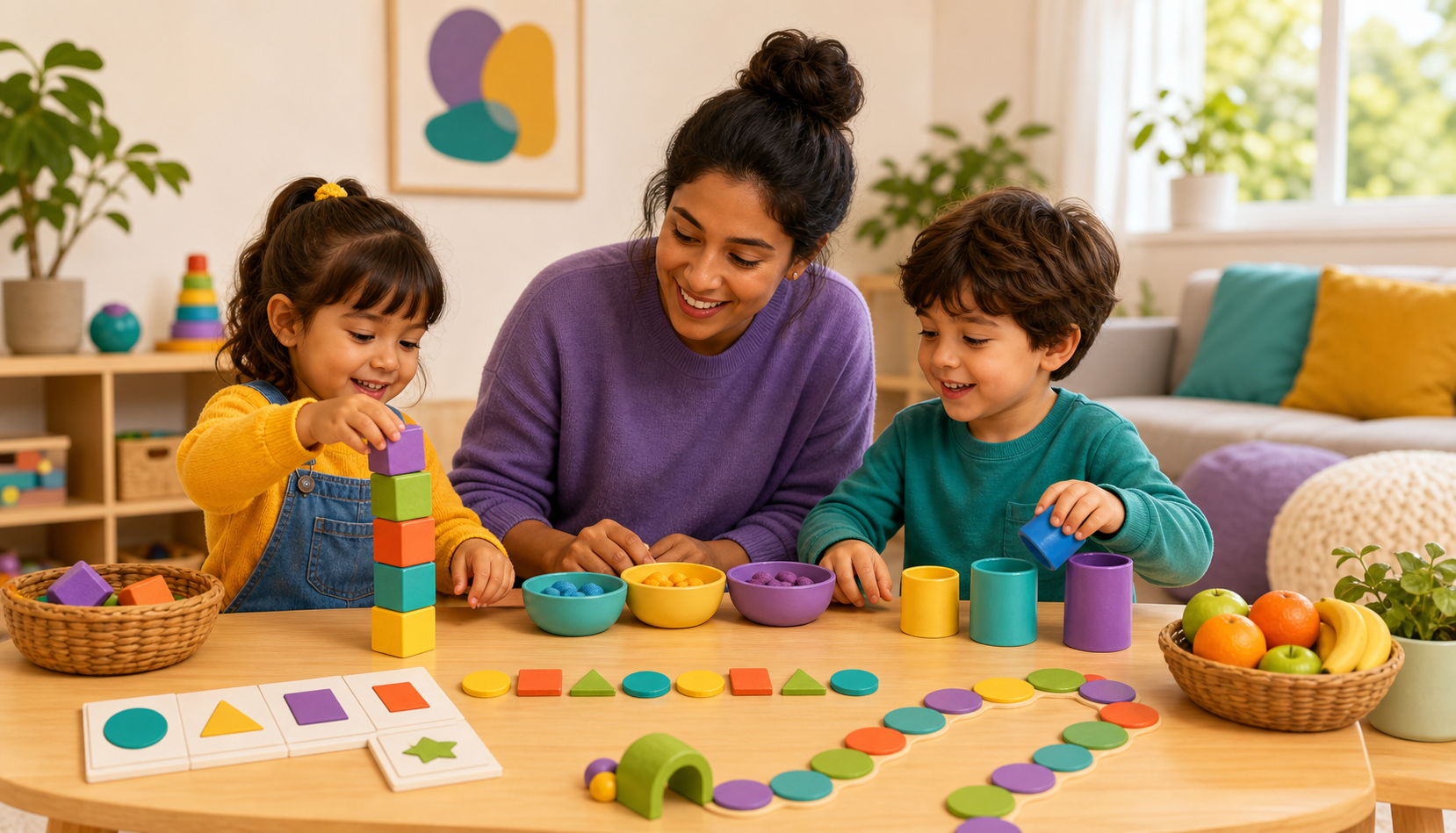
Why preschool maths at home matters
Early maths is not only about counting numbers. It includes number sense, comparison, patterns, shapes, measurement, spatial language, problem-solving, and simple reasoning.
That matters because early maths skills are strongly linked with later school success. A widely cited analysis published in Developmental Psychology found that school-entry maths, reading, and attention were the strongest predictors of later achievement, with early maths showing the strongest predictive power. PubMed summarizes the study clearly.
NAEYC and NCTM also describe high-quality mathematics education for children ages 3 to 6 as a foundation for future mathematics learning. Their position statement highlights that young children naturally compare quantities, notice patterns, sort objects, explore shapes, and solve real problems during play.
This is the part many adults underestimate.
A child arranging spoons by size is doing measurement. A child splitting biscuits fairly is meeting division informally. A child building a tower and saying, "Mine is taller," is using comparison language.
That is maths. Real maths. Not textbook maths yet, but the foundation underneath it.
The simple rule: concrete before paper
For preschoolers, the order should be:
- Touch real objects.
- Say what is happening.
- Compare, count, sort, or build.
- Draw or record it later.
Worksheets can help after a child understands the idea. But if the child has not handled real quantities, worksheet maths becomes copying. Clean pages. Weak concepts.
The What Works Clearinghouse practice guide, Teaching Math to Young Children, recommends daily maths learning and integrating maths into everyday routines. It also highlights games, mathematical language, and developmental progression as useful parts of early instruction.
At home, that does not mean one hour of formal teaching. It means five to fifteen minutes of purposeful play.
15 fun maths activities for preschoolers at home
Use these activities with children ages 3 to 6. Start easy. Repeat often. Preschoolers need repetition before speed.
| Activity | Best age | Maths skill | What to do | Parent script |
|---|---|---|---|---|
| Snack counting | 3-4 | One-to-one counting | Give 5 raisins or banana pieces. Ask your child to touch and count each one. | "Touch one piece for each number. Did we count every piece?" |
| Sock sorting | 3-5 | Classification | Mix socks by color, size, or pattern. Ask your child to make groups. | "How did you decide these go together?" |
| Block towers | 3-6 | Counting, comparison | Build two towers. Count blocks and compare height. | "Which tower is taller? Does taller always mean more blocks?" |
| Shape hunt | 3-6 | Geometry | Look for circles, squares, rectangles, and triangles at home. | "The clock is a circle. Can you find another circle?" |
| Pattern train | 4-6 | Patterns | Make red-blue-red-blue with blocks, buttons, or spoons. Ask what comes next. | "Tell me the rule. What should come after blue?" |
| Stair counting | 3-5 | Stable counting order | Count each step while walking slowly. Count backward while coming down. | "Let's count up. Now can we count back?" |
| Big-small basket | 3-4 | Size comparison | Put household objects in a basket and sort by big, small, long, short, heavy, light. | "Which one is heavier in your hand?" |
| Cup filling | 3-6 | Measurement | Use cups in the bath or sink. Compare full, half-full, empty, more, less. | "Which cup has more water? How do you know?" |
| Toy shop | 5-6 | Money sense | Pretend toys cost 1, 2, or 3 coins. Let your child buy and count coins. | "This car costs 3 coins. Count and pay exactly 3." |
| Number path game | 4-6 | Counting on, order | Draw boxes 1 to 10. Roll a die and move a toy along the path. | "You are on 4. You rolled 2. Count two jumps." |
| Fruit sharing | 4-6 | Equal groups | Share orange slices or grapes between two plates. | "Can we make both plates fair?" |
| Laundry pairs | 3-5 | Matching, pairs | Match socks or fold two similar towels together. | "A pair means two that belong together." |
| Spoon measurement | 4-6 | Nonstandard measurement | Measure a book, table, or mat using spoons or blocks. | "This book is 6 spoons long." |
| Weather graph | 5-6 | Data | Mark sunny, rainy, cloudy days for a week. Count which happened most. | "Which weather did we see the most this week?" |
| Story sums | 5-6 | Early addition and subtraction | Use toys for tiny stories: 2 cars came, 1 more came. | "Now how many cars are there altogether?" |
Look, none of this needs expensive material. If you have blocks, bowls, spoons, socks, cups, fruit, paper, and a pencil, you have enough.
Activity 1: Count snacks the right way
Snack counting is one of the easiest preschool maths activities because the quantity is small, real, and motivating. Use 3 to 10 pieces depending on your child's age.
The important part is one-to-one correspondence. That means one number word for one object. Many children can recite "one, two, three, four, five" quickly but skip objects while counting. Slow them down.
Try this:
- Put 5 raisins on a plate.
- Ask your child to touch one raisin and say "one."
- Move that raisin slightly aside.
- Continue until every raisin is counted.
- Ask, "So how many raisins are there?"
That final question matters. It teaches cardinality, the idea that the last number tells the total amount.
Activity 2: Sort toys, socks, and kitchen items
Sorting builds classification, logic, vocabulary, and attention. It is also beautifully simple.
Give your child 10 mixed objects. Blocks, spoons, toy cars, buttons, crayons, or socks all work.
Ask:
- Which things are the same color?
- Which things are big?
- Which things are small?
- Which things can roll?
- Which things are soft?
- Can you sort them another way?
The last question is the real win. When a child sorts the same objects by color first and then by size, they learn that one object can belong to different groups depending on the rule. That is early mathematical thinking.
Activity 3: Build patterns before writing numbers
Patterns are the bridge between playful preschool maths and later algebra. Yes, algebra. Quietly. Without scaring anyone.
Start with simple repeating patterns:
- red, blue, red, blue
- spoon, fork, spoon, fork
- clap, tap, clap, tap
- big block, small block, big block, small block
Ask your child to continue the pattern. Then ask them to explain it.
"The rule is red, blue, red, blue."
That one sentence is powerful. It teaches children to notice structure, not just copy what they see.
Activity 4: Play a number path game
A number path is easier for preschoolers than a number line because each number sits inside its own box or space. NAEYC's article on number path games explains that these games help preschool children practice counting, comparing numbers, one-to-one correspondence, and counting on.
Make one at home:
- Draw 10 boxes on paper.
- Write 1 to 10, one number in each box.
- Use a small toy as the game piece.
- Roll a die or use number cards from 1 to 3.
- Move the toy one box per count.
Start with 1 to 5 for younger children. Move to 1 to 10 when they are ready.
For ages 5 to 6, add questions:
- "You are on 6. What comes next?"
- "How many jumps to reach 10?"
- "If you move back 2 spaces, where do you land?"
This is much better than asking a child to fill random missing numbers on paper. They can see and feel the movement.
Activity 5: Compare, measure, and use maths words
Preschool maths needs language. Children should hear and use words like more, less, same, bigger, smaller, taller, shorter, heavier, lighter, full, empty, near, far, above, below, before, after, first, next, and last.
Use these words during normal routines:
- "Your glass has more water than mine."
- "This spoon is shorter than that spoon."
- "Put the teddy above the pillow."
- "Which line has fewer cars?"
- "Can you stand behind the chair?"
This builds the vocabulary children need before formal school maths. Many young children get confused in maths not because the idea is too hard, but because the language is unfamiliar.
What should a 3-year-old, 4-year-old, and 5-6-year-old practice?
Age matters. A 3-year-old and a 6-year-old should not get the same maths task with only bigger numbers.
Use this simple guide:
| Age | Focus on | Good activities | Avoid |
|---|---|---|---|
| 3 years | Counting small sets, matching, sorting, simple shapes | Snack counting, sock pairs, big-small baskets, shape hunt | Timed worksheets, large numbers, forced writing |
| 4 years | Patterns, comparing quantities, numbers up to 10, position words | Pattern train, block towers, cup filling, stair counting | Long sitting sessions, abstract sums too early |
| 5-6 years | Counting on, simple addition-subtraction stories, measurement, data | Number path games, toy shop, weather graph, story sums | Memorizing tricks without explanation |
If your child is ahead, give richer questions. If your child is struggling, reduce the numbers and make the activity more concrete.
That is not lowering expectations. That is teaching properly.
A 20-minute weekly plan for home
You do not need to do all 15 activities every week. Pick a few and repeat.
| Day | Time | Activity | Goal |
|---|---|---|---|
| Monday | 10 minutes | Snack counting | Count objects accurately |
| Tuesday | 10 minutes | Shape hunt | Notice geometry at home |
| Wednesday | 10 minutes | Pattern train | Continue and explain patterns |
| Thursday | 10 minutes | Cup filling | Compare more, less, full, empty |
| Friday | 10 minutes | Number path game | Count on and understand order |
| Saturday | 15-20 minutes | Toy shop | Use numbers in pretend play |
| Sunday | 5 minutes | Parent recap | Ask, "What maths did we play this week?" |
Keep it light. Preschoolers learn through repetition, but they also need joy. If the activity turns into a fight, stop and return later.
When home activities are not enough
Home play builds a strong foundation. But some children need a more planned learning path, especially when they are moving from preschool to KG, struggling with number sense, or ready for higher challenge.
That is where structured Online Maths Classes for Kids can help.
At Nino, our Maths Classes for ages 4 to 14 are built around outcomes, not random worksheets. For younger children, the focus is number sense, comparing and ordering, shapes, patterns, basic addition, basic subtraction, measurement, money, and time. As children grow, they move into grade-wise maths, STEM-focused problem-solving, board-aligned practice for IB, CBSE, ICSE, and State Boards, and Olympiad-style reasoning.
The best part is small batch attention. A teacher can see whether a child is actually understanding the idea or only copying the answer. That difference matters.
Common mistakes parents should avoid
Mistake 1: Starting with worksheets
Worksheets should record understanding, not replace it. Let the child count real spoons before circling spoon pictures on paper.
Mistake 2: Praising speed more than thinking
Fast wrong answers do not help. Ask your child, "How did you know?" That question builds reasoning.
Mistake 3: Using numbers that are too large
For preschoolers, small numbers are powerful. A deep understanding of 5 is better than shallow recitation to 100.
Mistake 4: Correcting too quickly
If your child says the longer line has more coins, even when both lines have 5, do not rush to correct. Ask them to count both lines and compare again. Let the idea click.
Mistake 5: Turning every moment into a lesson
Maths at home should feel natural. Count stairs sometimes. Not every single time. Children can smell an ambush.
Quick checklist: Is your child building real maths understanding?
Your preschooler is on the right path if they can:
- count small groups by touching one object at a time
- tell which group has more, fewer, or the same
- sort objects by one rule and then another rule
- continue a simple repeating pattern
- name basic shapes in real objects
- compare length, height, weight, and capacity with everyday words
- move along a number path one step per count
- solve tiny story problems with toys or snacks
- explain their thinking in simple words
Do not expect perfection. Expect progress.
Final takeaway
The best maths activities for preschoolers at home are simple, concrete, and repeated often. Count snacks. Sort socks. Build towers. Hunt shapes. Make patterns. Play number path games. Talk about more, less, same, bigger, smaller, first, next, and last.
That is how preschool maths becomes meaningful.
Not by making a 4-year-old sit with a pencil for 45 minutes.
By helping them see that maths is already around them.
FAQs
What are the best maths activities for preschoolers at home?
The best preschool maths activities are hands-on games like snack counting, toy sorting, block towers, shape hunts, pattern trains, cup filling, number path games, and pretend toy shops. These build number sense, geometry, measurement, comparison, and reasoning before worksheets.
How do I teach maths to a 3-year-old at home?
Teach a 3-year-old maths through tiny real-life moments. Count 3 to 5 snack pieces, match socks, sort toys by color, compare big and small objects, and name circles or squares at home. Keep lessons playful and under 10 minutes.
Should preschoolers use maths worksheets?
Preschoolers can use worksheets after they understand the concept with real objects. Start with counting blocks, sorting spoons, making patterns, and measuring with cups. Then use a short worksheet to record or review the idea, not to introduce it.
What maths should a 5-year-old know before Grade 1?
A 5-year-old should work on counting small sets, comparing more and fewer, recognizing numbers up to 10 or 20, naming shapes, making patterns, using position words, measuring informally, and solving simple addition-subtraction stories with objects.
How often should I practice maths with my preschooler?
Practice preschool maths for 5 to 15 minutes most days. Short, repeated activities work better than one long session. Use everyday routines like snacks, stairs, bath time, laundry, and toy cleanup so maths feels natural instead of forced.